
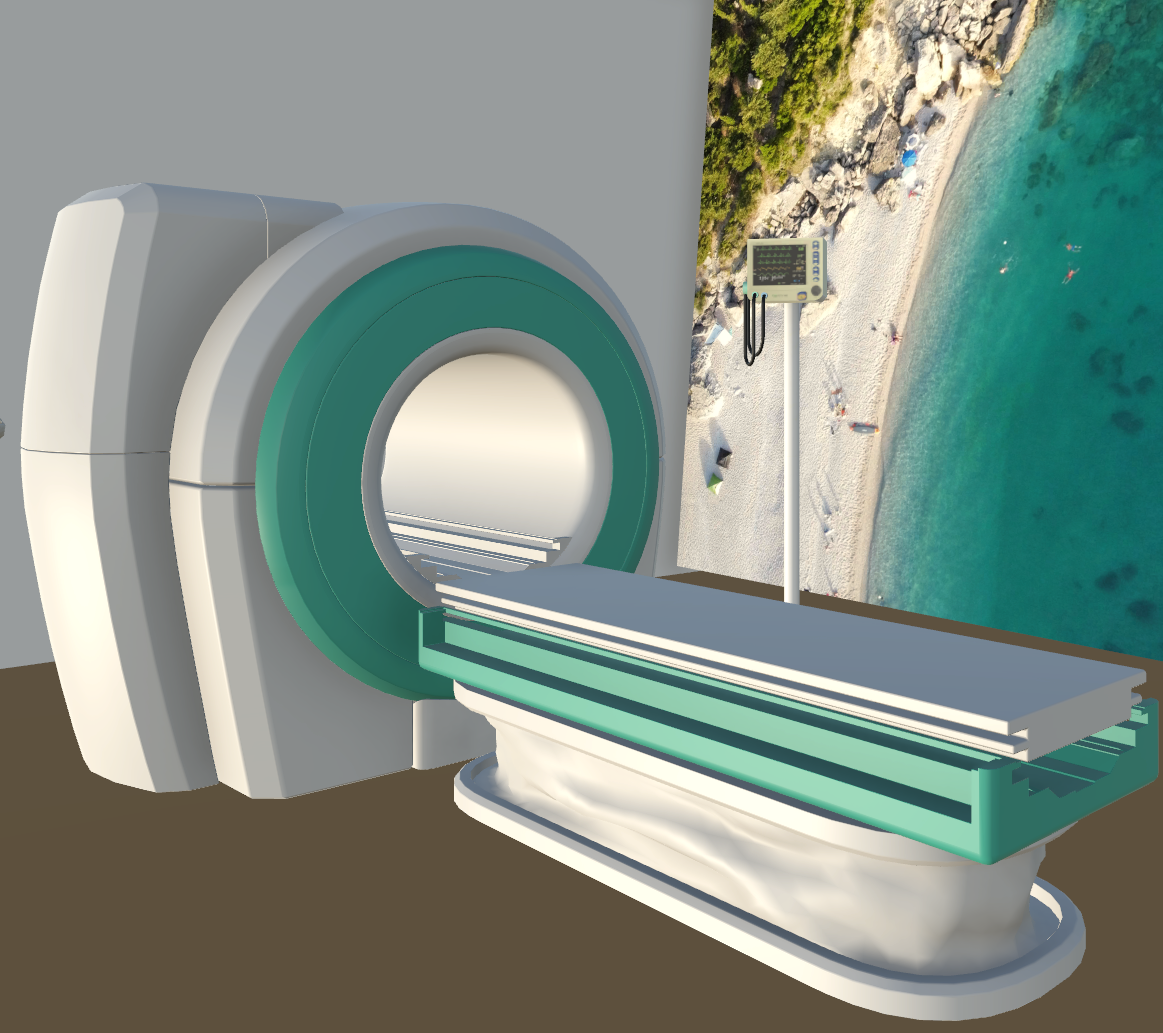
Magnetic Resonance Imaging (MRI) is one of the most widely used medical imaging technologies, playing a critical role in diagnosing and monitoring a broad range of conditions. Despite its clinical importance, MRI procedures can be intimidating for many patients due to the confined scanner environment, loud acoustic noise, and the requirement to remain still for extended periods. These challenges can lead to anxiety, motion artifacts, incomplete scans, and, particularly in pediatric populations, the need for sedation. Our research explores how immersive technologies, including virtual reality (VR), 360° media, and mobile platforms, can improve patient preparation, reduce anxiety, and increase procedural success through engaging and accessible MRI familiarization experiences.
Exploring Immersive MRI Preparation Across Mobile and HMD Platforms
To increase access to MRI preparation tools, this project investigates how different levels of immersion influence anxiety, presence, and user experience across both smartphone and head-mounted display (HMD) platforms. By comparing traditional video, 360° media, and interactive VR experiences, the work examines the trade-offs between accessibility and immersion, informing the design of scalable at-home preparation solutions.
Reference:
Hosseini Toudeshky, H., Yang, J., Hudson, M., et al. Exploring Immersive MRI Preparation Across Mobile and HMD Platforms. Accepted to MobileHCI 2026.
Evaluating the Impact of Immersiveness in Virtual Reality Simulations on Anxiety Reduction for MRI Procedures
This preliminary study examines how varying levels of VR immersion affect anxiety responses during MRI preparation. Using physiological sensing and self-report measures, the research compares 2D video, 360° video, and fully immersive VR simulations to better understand how realism and presence contribute to anxiety reduction and patient preparedness.
Reference:
Hosseini-Toudeshky, H., Seidnitzer, S., Bickelhaupt, S., Harmouche, R., & Kersten-Oertel, M. (2025, March). . In 2025 IEEE Conference Virtual Reality and 3D User Interfaces (VR) (pp. 613-622). IEEE.